Diana Márquez at the presentation of the 2026 Annual Report of the Comisión Provincial por la Memoria
The CPM presented «El sistema de la crueldad XX», its annual report on places of confinement, security policy, mental health and childhoods in the province of Buenos Aires. SAJuR’s president took part as a guest, in her capacity as national coordinator of Víctimas por la Paz.
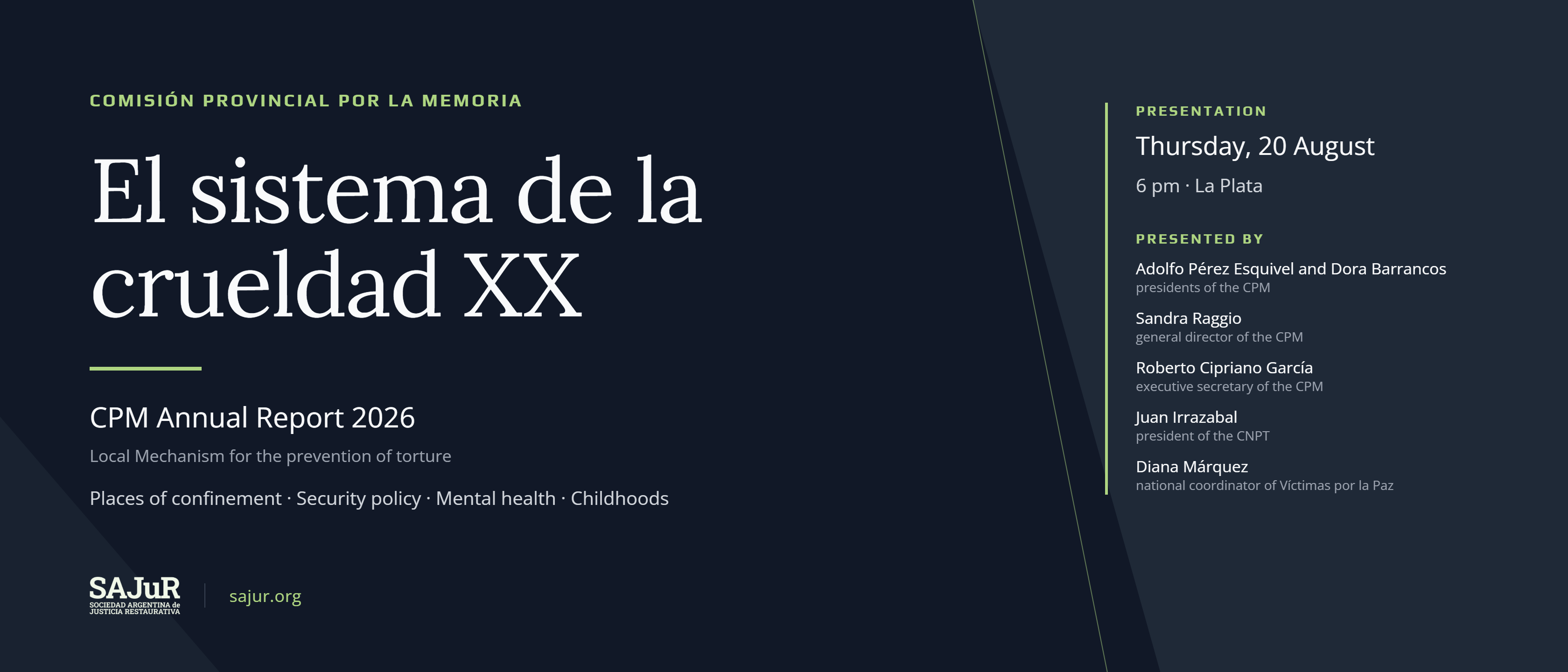
On Thursday 20 August, the Comisión Provincial por la Memoria (CPM) presented «El sistema de la crueldad XX», the twentieth edition of its annual report on conditions of detention and the deployment of security forces in the province of Buenos Aires.
Diana Márquez took part in the presentation as a guest, in her capacity as national coordinator of Víctimas por la Paz. The report was presented by Adolfo Pérez Esquivel and Dora Barrancos, presidents of the CPM, Sandra Raggio, its general director, and Roberto Cipriano García, its executive secretary. Juan Irrazabal, president of the National Committee for the Prevention of Torture, also took part.
What the report is
It is not a collection of scattered complaints. The CPM produces it in its capacity as Local Mechanism for the Prevention of Torture, drawing on its own work of oversight and monitoring in places of confinement: a diagnosis built from what its teams see inside, year after year.
This edition covers four areas the series has been following: places of confinement, security policy, mental health and childhoods. Each year the CPM presents it as a contribution to public debate on human rights.
Both ends of the system at the same table
That the president of the National Committee attended the presentation of the Local Mechanism’s report is not a matter of protocol. The system for preventing torture works on two levels that depend on each other: the one that walks into places of detention, and the one that carries what it finds to a national scale. When those two levels listen to each other, what is documented inside has somewhere to go.
Why this concerns us
SAJuR works with the CPM in contexts of confinement, and with Víctimas por la Paz in accompanying people who have been harmed. These are two of our alliances, and at this event they met.
There is something restorative justice cannot avoid: you cannot repair inside a system that harms. A restorative encounter requires that the parties be able to speak under minimal conditions of dignity, and that includes whoever is deprived of their liberty. Documenting what those conditions are —by name, with data and with method— is what makes it possible to discuss anything else afterwards. That is why a report like this is not foreign to the restorative approach: it is its foundation.
The presentation took place at the Sergio Karakachoff Building of the Universidad Nacional de La Plata (48th St. No. 575, room 203, second basement) and was streamed live on the CPM’s YouTube channel.